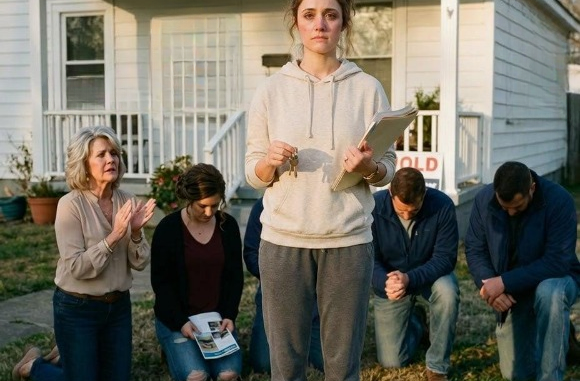
My family kicked me out after I refused to pay for my sister’s retreat and instead bought an $800 house from a county auction. My mom mocked me, saying, “Enjoy living like junk.” Now, suddenly, they want a share of it.
It started late at night—11:43 p.m.—when pounding shook the front door so hard dust fell from the ceiling beams. I froze in the middle of my small living room, keys in one hand, phone in the other.
“Open this door, Leah!” my mother’s voice snapped from the porch. “You think you can steal from this family and hide in this dump?”
Something slammed against the house siding. My sister Rachel called out, breathless, “She’s in there. I saw her car.”
My stomach tightened.
The house had cost me just eight hundred dollars at a tax auction outside Millfield, Ohio. It was rundown, cold, and barely livable—but it was mine. I had bought it instead of funding Rachel’s expensive “healing retreat,” and my family had never forgiven me.
My mother had once sneered, “Enjoy living like junk.”
So I did. I fixed leaks, scrubbed mold, slept on an air mattress—and stayed away from them.
Until tonight.
Earlier that day, a man in a gray truck had stopped by and warned me quietly, “If your family shows up… don’t let them in.”
Now they were here.
My phone buzzed.
DO NOT OPEN THE FLOOR IN THE KITCHEN. THEY KNOW.
Before I could react, something hit the front door hard enough to crack the frame.
Rachel shouted, “She found it before us!”
Found what?
A violent snap came from the kitchen. A floorboard lifted sharply, revealing a hidden space beneath the house.
Cold air rushed up.
And then the front door burst open.
My mother stormed in first, followed by Rachel and my uncle Brent, holding something heavy in his hand.
“Move,” my mother said instantly, eyes locked on the floor.
“No.”
That was all it took.
Brent stepped forward. Rachel rushed the opening and pulled out a rusted metal box.
Inside, there was no money. No valuables.
Only documents, a weapon, an old photo—and a yellowed envelope labeled:
MARA
My grandmother.
The room shifted instantly.
Rachel asked, confused, “Why is Grandma’s name on this?”
The silence that followed was heavier than anything before it.
When I opened the letter, everything I thought I knew collapsed.
It revealed that the house wasn’t random or worthless—it had belonged to my grandmother Mara Carter, who had uncovered land fraud and hidden proof beneath the floor. The property wasn’t just real estate; it was evidence of something deeply criminal tied to my own family.
And worse—it had been left to me.
Not them.
Me.
Before I could process it fully, headlights appeared outside.
The gray truck returned.
A gunshot shattered the window.
A man’s voice called from outside: “Leah! Your grandmother told me you’d need this proof when they came back for it.”
Everything spiraled into chaos as the truth unraveled—about fraud, stolen land, and a death my family had buried for years. My uncle lunged for control, my mother broke down between denial and guilt, and Rachel realized too late she had been kept in the dark her entire life.
By the end of the night, police were involved. My uncle was arrested. My mother gave a statement that kept her out of prison. And the man from the truck—Eli, my grandmother’s hidden ally—helped confirm everything in the documents she left behind.
What I had bought for $800 wasn’t junk.
It was a property worth millions—and a buried history my family had tried to erase.
Months later, after the dust settled, I kept the house.
I restored it, piece by piece, until it no longer looked abandoned or forgotten. I even preserved the hidden compartment—sealed under a plaque bearing my grandmother’s name.
My mother once told me to “enjoy living like junk.”
But in the end, I stood on the front steps of that same house, watching the light fall across its restored walls, knowing the truth was finally exposed—and it belonged to me just as much as the home did.
Leave a Reply