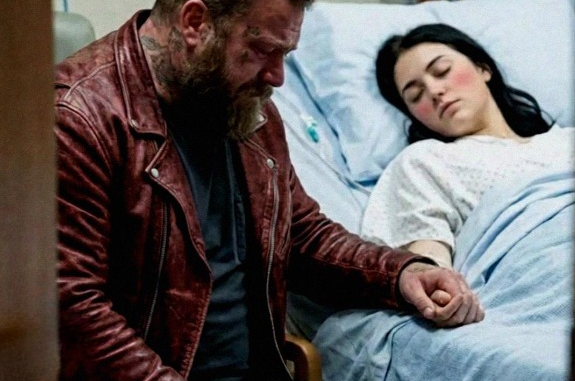
For six months straight, a large biker with a gray beard entered my comatose 17-year-old daughter’s hospital room every day at exactly 3 p.m., held her hand for an hour, and then left—while I, her mother, had no idea who he was or why he was there.
I’m Sarah, 42. My daughter Hannah is 17.
Six months ago, a drunk driver ran a red light and crashed into her driver’s side while she was coming home from her job at a bookstore.
Since then, she’s been in room 223 in a coma, surrounded by machines I never knew existed. I basically live there now—sleeping in a recliner, eating from vending machines, learning the routines of the hospital and the staff.
And every day at 3 p.m., the same thing happens.
A man arrives.
He’s huge, with a gray beard, leather vest, boots, and tattoos. He nods politely at me, then walks to my daughter.
“Hey, Hannah,” he says. “It’s Mike.”
He sits beside her, takes her hand, and stays for an hour. Sometimes he reads books aloud. Sometimes he just talks quietly about his day, always speaking to her as if she can hear him.
At 4 p.m. sharp, he gently places her hand back on the blanket, nods at me, and leaves. Every single day.
At first, I ignored it. When your child is in a coma, you accept any sign of kindness you can find. The nurses even treated him like he belonged there.
But eventually, I couldn’t take it anymore.
He wasn’t family. He wasn’t a friend. No one I knew recognized him.
So one day, I asked a nurse who he was. She only said he was “a regular” who cared.
That wasn’t enough.
So after he left one afternoon, I followed him into the hallway.
When I confronted him, he already knew my name. That unsettled me.
We sat down, and I demanded answers.
After a long silence, he told me the truth.
His name was Mike. He was 58. He had a wife and a granddaughter.
And then he admitted it.
He was the drunk driver who hit my daughter.
The room felt like it collapsed around me.
He explained everything—his arrest, his guilty plea, jail time, rehab, sobriety. He said none of it changed what happened. He said he came because he needed to face what he had done, not run from it.
He said he started coming after his sentence, sitting in the lobby at first, then eventually being allowed to sit with her. He read the books she liked, learned about her through others, and chose 3 p.m. because it matched the time of the crash.
“I can’t undo it,” he said. “But I can show up.”
I was furious. I told him to stay away.
For the first time in months, the room stayed quiet at 3 p.m. No leather vest. No voice reading to my daughter.
But something about it didn’t feel like relief.
A nurse later told me she had never seen anyone show up so consistently.
Eventually, I went to an AA meeting where he spoke. He openly admitted what he had done, calling himself responsible for the crash. Afterward, I told him I didn’t forgive him—but I agreed he could return to the hospital, on one condition: I would be there.
So he came back.
Day after day, he sat beside her again, reading to her. Slowly, small changes began to happen. Her monitor stabilized when he spoke. Then one day, her hand squeezed mine.
I panicked.
Doctors rushed in.
And then she whispered, “Mom?”
Everything changed after that.
Later, when she was strong enough, we told her the truth—that Mike was the driver.
She was quiet for a long time. She told him she didn’t forgive him. He said he understood.
But she also said she didn’t want him to disappear.
Recovery was long and painful. Therapy, frustration, setbacks. But Mike kept showing up—never forcing anything, just being there when she allowed it.
Eventually, she began walking again. Slowly, with help.
Over time, she even accepted his presence during recovery. Not forgiveness—but acknowledgment.
Now she’s back to working part-time and preparing for college.
Mike is still sober. Still present. Still part of her life in a limited, careful way.
And every year on the anniversary of the crash, at exactly 3 p.m., the three of us meet at a small coffee shop near the hospital.
We don’t give speeches.
We just sit together.
Because it isn’t forgiveness.
And it isn’t forgetting.
It’s simply three people trying to move forward without pretending the past didn’t happen.
Leave a Reply