The Music Teacher Mocked a Biker Grandpa at a Prestigious Academy—But When His Granddaughter Played Liszt, His 25-Year Secret as a Juilliard Pianist Left the Entire Concert Hall Speechless
People often believe they can understand someone the instant they see them. A leather vest signals trouble. Tattoos suggest danger. The roar of a motorcycle makes people assume the rider must be reckless or intimidating. It’s a convenient mental shortcut—placing others into tidy categories so we don’t have to question our assumptions. Yet sometimes life creates moments that completely shatter those boxes, leaving everyone wondering how they ever believed something so shallow in the first place.
The remarkable story that unfolded at Riverside Conservatory that spring evening actually began earlier that day with a simple request from a fragile elderly woman standing near a grocery store parking lot. In most situations, the question might have seemed unusual—but to the men she approached, it carried a deeper meaning.
Her name was Margaret Doyle. At eighty-six, she had recently lost her husband and now lived alone in a modest apartment above a laundromat just three blocks from the river. Five years earlier, a construction accident had taken her only son. What remained were photographs, memories, and a quiet sorrow that time had never fully erased.
Margaret had grown accustomed to the stillness of her days. She prepared small meals for one, watered the same aging houseplants she’d cared for for decades, and sometimes spent entire afternoons by the window watching people pass along the street below.
But that particular morning felt different.
It was Mother’s Day.
For many people, the holiday meant flowers, brunch, and family gatherings. For Margaret, it meant something quieter—a visit to the cemetery where her son was buried. She planned to go early, place a small bouquet of daisies on his grave, and return home before the afternoon crowds arrived.
Yet when she reached the bus stop beside the grocery store, something unexpected caught her attention.
Across the street, nearly twenty motorcycles pulled into the parking lot of a diner.
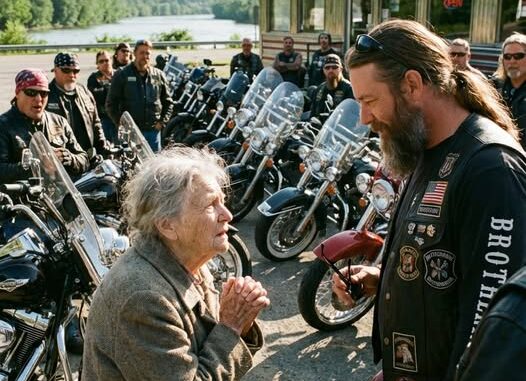
They arrived like distant thunder—engines rumbling, chrome flashing in the sunlight, leather jackets stitched with bold patches. A group of Hells Angels riders climbed off their bikes and gathered near the entrance, greeting each other with laughter and the easy familiarity of longtime friends.
Most pedestrians walking by avoided looking at them.
Margaret didn’t.
Instead, she slowly crossed the street.
The riders noticed her right away. An elderly woman approaching a gathering of bikers tends to draw attention, and conversations faded as she reached the edge of the group. One man stepped forward—a broad-shouldered rider with gray streaks in his beard.
“Are you alright, ma’am?” he asked kindly.
Margaret clasped her hands together nervously. Her voice trembled slightly.
“Would one of you mind pretending to be my son today?”
The riders exchanged puzzled glances.
Before anyone could misunderstand, Margaret quickly explained.
“My son used to take me to the cemetery every Mother’s Day,” she said softly. “I can’t drive anymore… and the bus route changed last month. I just thought…” Her voice faltered.
“I thought maybe if someone walked with me, it wouldn’t feel so lonely.”
The gray-bearded biker studied her quietly.
His name was Gabriel “Grave” Navarro—fifty-nine years old, a Vietnam Marine veteran, motorcycle mechanic, and longtime member of the Riverside Hells Angels chapter.
After a moment, he removed his sunglasses.
“Ma’am,” he said gently, “it would be my honor.”
The Ride
Fifteen minutes later Margaret sat carefully behind Gabriel on his Harley, gripping the seat with trembling hands. A dozen other bikers followed them out of the parking lot like an escort, their engines echoing through the neighborhood streets.
People on the sidewalks stared.
Some looked uneasy.
Others simply looked confused.
But Margaret felt something she hadn’t experienced in years.
Safe.
They reached the cemetery just before noon. Gabriel parked near the entrance and offered his arm so she could step down carefully. The other riders waited quietly while Margaret walked to her son’s grave.
She knelt slowly, placing the daisies against the headstone.
For several minutes, no one spoke.
Then she looked up at Gabriel, her eyes shining with tears.
“Thank you for pretending,” she said softly.
Gabriel shook his head.
“I wasn’t pretending.”
That quiet moment—small and sincere—became the beginning of something none of them could have imagined.
Before leaving the cemetery, Margaret asked one more question.
“My granddaughter has a recital tonight,” she said shyly. “Would it be terribly strange if… if you came with me?”
The Conservatory
Riverside Conservatory was not a place where leather jackets and motorcycle boots usually appeared.
The elegant building was filled with wealthy donors, refined parents, and students who had studied classical music since early childhood. Marble floors gleamed beneath chandeliers, and framed portraits of famous alumni decorated the hallways.
Margaret’s granddaughter, Elena Rivera, had been studying there on scholarship for two years.
She was sixteen, exceptionally talented at the piano, and painfully aware that most of her classmates came from wealthy families who could afford private tutors and European summer programs.
Her mother—Margaret’s daughter—worked two jobs to support them.
Money was always tight.
When Elena arrived backstage that evening, she was already nervous. She wore a simple black dress purchased secondhand but carefully pressed that morning. Around her, other students wore designer gowns and polished dress shoes.
Then she noticed something through the lobby window.
Motorcycles.
A lot of them.
Within minutes fifteen Hells Angels riders entered the conservatory lobby alongside Margaret Doyle.
The room fell silent.
Parents whispered nervously.
Security guards exchanged uncertain looks.
And Elena nearly fainted.
“Grandma,” she whispered when Margaret reached backstage, “what is happening?”
Margaret smiled warmly.
“These men helped me visit your father today,” she said. “I invited them to hear you play.”
Elena glanced toward the riders standing respectfully near the back of the hall.
They looked enormous in the elegant room—leather vests, heavy boots, weathered faces.
But their expressions were calm.
Almost protective.
The Teacher’s Doubt
Unfortunately, not everyone shared Margaret’s trust.
Elena’s instructor, Professor Harold Whitmore, had built his reputation teaching students from wealthy families. He valued discipline, technical perfection, and reputation above all.
When he saw the bikers enter the hall, his expression tightened.
“Elena,” he said sharply, “who are those men?”
“My grandmother invited them,” she replied quietly.
Whitmore sighed.
“Tonight is not the time for… theatrics.”
Elena lowered her eyes.
For the recital, she had been assigned Beethoven’s Für Elise—a relatively simple piece compared to the demanding works other students were performing.
Whitmore believed she lacked the “refinement” required for more advanced compositions.
What he didn’t know was that Elena had been secretly practicing something far more difficult.
Because the quiet biker sitting in the back row—Gabriel Navarro—was not just a motorcycle rider.
He was a former Juilliard pianist who had abandoned music decades earlier after losing his family.
And he had been teaching Elena.
The Secret
After visiting the cemetery that morning, Margaret mentioned Elena’s recital while sharing coffee with Gabriel and the other riders. When she explained Elena’s scholarship and her teacher’s doubts, Gabriel became thoughtful.
“Does the girl love music?” he asked.
Margaret smiled.
“It’s the one place she forgets the world exists.”
So Gabriel visited their apartment that afternoon.
He sat at the old upright piano in the living room.
When his fingers touched the keys for the first time in twenty-five years, the room filled with the powerful opening chords of Liszt’s Hungarian Rhapsody No. 2.
Elena stared in disbelief.
“Where did you learn to play like that?”
“Juilliard,” he answered quietly.
For six hours that afternoon, he coached her through the piece—not perfectly, but passionately.
“Music isn’t about perfection,” he told her. “It’s about truth.”
The Performance
Now the moment had arrived.
The recital began normally. Students performed Chopin and Rachmaninoff with polished technique while parents recorded videos.
Finally Elena’s name was announced.
She stepped onto the stage, her heart pounding.
Professor Whitmore stood near the wings, arms folded.
“Remember,” he whispered sternly, “Für Elise.”
Elena sat at the piano.
For a moment, the hall fell silent.
Then she spoke into the microphone.
“I was supposed to play Beethoven tonight,” she said calmly.
Murmurs rippled through the audience.
“But I’d like to play something else.”
Whitmore’s face drained of color.
“Absolutely not—”
But before he could stop her, Elena’s hands struck the keys.
The explosive opening chords of Liszt’s Hungarian Rhapsody No. 2 thundered through the hall.
Gasps echoed around the room.
The piece was far beyond student-recital level.
Whitmore froze.
Because what followed wasn’t a nervous attempt.
It was extraordinary.
Her fingers raced across the keyboard with speed and emotion, every phrase filled with passion learned not in elite studios—but in a small apartment above a laundromat.
In the back row, Gabriel watched quietly as tears filled his eyes.
Twenty-five years earlier, he had dreamed of performing again.
Now his music lived through someone else.
As Elena reached the blazing final section, the audience leaned forward in stunned silence.
When the last chord crashed through the hall, no one moved.
Then applause exploded like thunder.
People stood.
Even Professor Whitmore slowly joined in.
The Truth Revealed
After the performance, a conservatory board member approached Elena.
“Who trained you for that piece?” he asked.
Elena turned toward the back row.
Gabriel hesitated before standing.
When someone mentioned he had studied at Juilliard, disbelief spread through the hall.
But a quick phone call confirmed it.
Records showed Gabriel Navarro had once been one of the institution’s most promising young pianists.
The revelation stunned everyone.
The biker they had silently judged all evening had once been exactly the kind of musician their academy celebrated.
Professor Whitmore approached him slowly.
“I owe you an apology,” he admitted.
Gabriel shrugged.
“Don’t apologize to me,” he said calmly. “Apologize to her for underestimating her.”
A New Beginning
By the end of the night, the atmosphere had completely changed.
Parents who had once avoided the bikers now shook their hands.
Students asked Elena about her practice routine.
And Margaret Doyle sat quietly in the front row, smiling.
Her strange request that morning had changed far more lives than she had expected.
Before leaving, Gabriel knelt beside her chair.
“Thank you for asking me to pretend,” he said.
Margaret squeezed his hand gently.
“I told you,” she replied. “You weren’t pretending.”
The Lesson
People often judge others based on appearance, reputation, or circumstance, forgetting that every person carries a deeper story. True character isn’t revealed through clothing or status—it appears through kindness, loyalty, and the courage to show up for others when it matters most. Sometimes the people society misunderstands are the very ones capable of remarkable compassion. And sometimes a simple act of trust can uncover hidden brilliance where no one expected to find it.
Leave a Reply