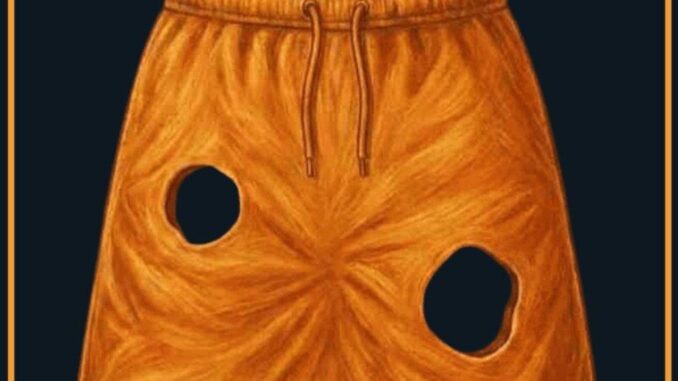
Online puzzles have a way of turning even the simplest images into lively debates, and this skirt riddle is a great example. At first glance, it seems easy—you see a skirt with a few noticeable tears and a straightforward question: how many holes are there? But within moments, people start doubting themselves, zooming in, recounting, and confidently arguing for completely different answers.
That’s exactly what makes this puzzle so entertaining.
Viewers are asked to count the holes in the skirt, with answers ranging from 2 to 7. Some quickly say 2, focusing only on the two obvious tears. Others argue it’s 4, reasoning that each tear goes through both the front and back, effectively doubling the count. Then there are those who include the waistband opening and the bottom of the skirt, pushing the total even higher.
Suddenly, a simple image turns into a test of logic.
What makes puzzles like this so addictive is that they go beyond observation—they challenge how you define a “hole.” Are you only counting rips in the fabric? Or every opening in the garment? Do the small drawstring holes near the waistband count as well? This is where opinions start to differ, and often the discussion becomes more entertaining than the puzzle itself.
One common explanation goes like this: there’s one opening at the top, one at the bottom, and two visible tears. If those tears pass all the way through, they could count as four holes instead of two. Some people also add the two small drawstring openings near the waistband. Depending on how you interpret it, the total can quickly change.
That’s why so many people come up with different answers—and still feel completely right.
Of course, the claim that your answer “reveals if you’re a narcissist” is just playful clickbait. A simple visual puzzle can’t determine personality or mental health. Its real purpose is to catch attention and spark curiosity—and it succeeds.
These viral riddles thrive because they encourage instant interaction. People enjoy sharing their answers, defending their reasoning, and comparing with others. Even without a single correct solution, the puzzle works because it gets people talking. In the end, it’s less about being right and more about rethinking something that initially seemed obvious.
Another reason they spread so quickly is their accessibility. Anyone can join in—no special skills or knowledge required. Just a keen eye, a few seconds of focus, and maybe a willingness to debate small details.
So, what’s the correct answer?
It all depends on how you define a hole. Count only the large tears, and you might say 2. Include both sides of those tears, and it could be 4. Add the natural openings and possibly the drawstring holes, and the number climbs higher. That’s what makes it interesting—it’s as much about reasoning as it is about seeing.
In the end, the real puzzle isn’t the skirt.
It’s how your mind chooses to interpret what’s in front of you.
Leave a Reply