Part 2
By 8:03 the next morning, my director was at my office. He wore a wrinkled county-issued shirt and held Marmalade’s intake file like it had personally offended him.
He didn’t sit. Closing the door behind him, he stayed standing—a signal that this conversation was meant to feel shorter than it would.
“You put me in a bad position yesterday,” he said. No greeting. No small talk. Just that.
I hadn’t even taken my coat off. My coffee was still too hot to sip.
“I know,” I said.
He looked more tired than angry, which made it worse. Anger is simple. Tiredness means he had already played this out in his head before speaking.
“You can’t remove animals from the list just because a case affects you more than the others.”
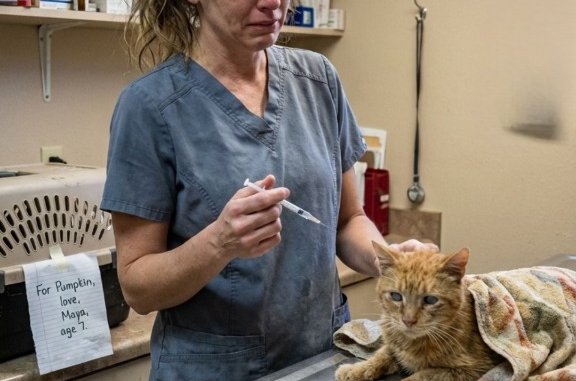
I stared at the file in his hand. A note was clipped to it, letters big and crooked: Please don’t make him scared.
“I didn’t pull him because he hit me harder,” I said.
He gave me a long look. We both knew that wasn’t completely true.
He placed the file on my desk.
“Rachel, I’m not the villain in your grief story. Yesterday we had six intakes. We were over capacity by noon. Numbers didn’t change because you had a conscience crisis at 3:58.”
He wasn’t cruel. He was saying something harder: truth.
I sat slowly.
“So fire me.”
“I don’t want to fire you,” he said.
“Then what?”
“I want you to remember everyone here carries something.” He gestured toward the kennel wing. “Lena went home crying. Marisol covered intake while everyone scrambled. Theo stayed late to clean runs. Volunteers are asking why staff get to pick favorites.”
That hit me—not because it was unfair, but because it was fair. I thought of Marmalade sleeping on Caleb’s old blanket—warm, alive—and then of the empty kennels I had passed last night without thinking too much about who had filled them.
“Did they make it?” I asked.
He knew who I meant. His jaw tightened.
“Not all of them.”
The room fell silent. Saving one life doesn’t guarantee the rest survive. Sometimes it only means someone else must decide which heartbreak is processed.
I looked at my hands. Steady. Almost maddeningly so.
He softened slightly. “I’m approving him as a hospice foster under your name. Off the shelter, off our books except for medical tracking. That keeps staff from thinking this is open season.”
“You’re approving it?”
“I’m containing it,” he said. Tapped the note once. “And Rachel, you don’t get to turn one saved cat into a sermon about the rest of us.” Then he left.
I stayed there long after the door closed. Some sentences you argue with. That one isn’t one.
At 9:17 the phone rang. I almost let it go. Picked up on the fourth ring.
“County Animal Shelter. Dr. Boone.”
A woman’s shaky voice: “Yesterday an orange cat was surrendered…old…in a blue carrier with tape. There was a note.”
“Yes,” I said.
“Did he go easy?”
Her words weren’t about rescue. They were about mercy: that what was loved hadn’t been terrified at the end.
“Your name?” I asked.
“Nina. He belonged to my mother. My daughter wrote the note.”
I leaned back, picturing the grandmother, the daughter, the child—cutting pieces of themselves just to survive.
“Nina, Marmalade is alive.”
There was a pause. Then muffled, careful crying.
“My daughter hasn’t slept since yesterday,” she whispered.
“How old?”
“Nine. Addie.”
I recognized her handwriting. Trying to be brave, failing at letters before feelings.
She told me the story in fragments: her mother Lorraine Mercer, 76, had fallen, had a stroke, then a cascade of complications. Nina had been helping while struggling with housing and finances. They tried everywhere for Marmalade—no options.
“I told her he might have missed Grandma anyway,” Nina admitted.
“Lie,” I said.
“Yes,” she whispered.
“He slept by my mother’s feet after my father died…even after the stroke, he followed her room to room. She said he was the only man left in the house who listened.”
I smiled despite myself. Then I thought of the note.
“Does Lorraine know he’s gone?”
“She knows something is.”
Worse than knowing by name: feeling the absence.
“She asked this morning where her orange boy was,” Nina said.
There it was: the question after mercy. Who gets him—the family who loved him, or the safer foster home that existed because I stepped in?
A knock. Lena. I signaled “wait.”
“Nina, do you want to see him?” I asked.
“Yes,” came fast. Then slower, “But I don’t know if that’s fair.”
Fair—to the cat, the grandmother, the child, the overfull shelter, the staff? Real life asks the math behind “fair.”
“When can you come?”
“Today?”
At 12:40, I drove home. Marmalade was on the couch, tucked in Caleb’s blanket like a little king. He lifted his head, blinked slowly, then pressed his face into my hand.
Still old. Still thin. Still carrying the years. But not dying today.
He ate lunch. Licked the bowl. I laughed—surprised, small.
At 2:05 Nina arrived with Addie. Addie’s purple hoodie too big, sleeves too short, hands twisting strings nervously. Nina looked exhausted, worn by long nights of caregiving.
I took them to an exam room.
“Before we start, we didn’t dump him,” Nina said.
“I know,” I said.
“My sister said we did.”
“Some people only recognize love when it comes with money and space. They’re not always right,” I said.
Nina’s face changed. Not because anything was solved, but because someone finally said the truth aloud.
I drove them to my apartment. Marmalade was awake. Recognition lit him. Addie whispered, “Baby.” He climbed onto her lap.
She asked quietly, “Can Grandma see him?”
He knew. Animals sense the absence in a family.
Lorraine was at Cedar Glen Residence. No pets allowed. The words were clean, practical, merciless.
“When was the last time she saw him?”
“The ambulance day.”
“We’re going,” I said.
At Cedar Glen, administrators were wary. No-resident-animal policies, allergies, overworked staff. I explained our request: one room, one resident, one cat, supervised.
Ms. Hadley, navy cardigan, listened, then said, “Ten minutes. Private family room. Carrier in and out. If anyone objects, the visit ends.”
“Yes,” we all said.
Lorraine didn’t look like I imagined. Small. Hospital-small. Institution-small. But soon, Marmalade was with Addie, recognition and love clear.
It was as if the world had measured her and decided there was too much grief, too much need, too much of her, and pared her down accordingly.
Lorraine sat in a wheelchair by the family room window, her gray hair brushed back, hands folded in her lap, eyes fixed on the distance. That look—I had seen it before. Not absence exactly, but waiting where nobody else could see the door.
“Mom,” Nina said. Lorraine turned slowly. Addie knelt beside her. “We brought somebody.”
I opened the carrier. For a second, Marmalade didn’t move. Then he caught the air, lifted his head, gathered himself, and stepped out. Straight to Lorraine’s feet. Not to Nina, not to Addie, not to me. Straight to her.
He rubbed against her legs, then rose onto his hind feet, paws on her knees, letting out a ragged little sound that cracked the quiet of the room. Lorraine’s face changed—just one word escaped: “Oh.”
Her hand shook as it lowered to his head. Marmalade pressed into it, nearly losing his balance, and began to purr. Old. Broken. Earned.
“There you are,” she whispered.
Addie cried quietly. Nina made a soft sound. Lorraine kept petting him, tracing time backward by touch alone. He circled once at her chair, then laid across her slippers—exactly where he belonged.
No one spoke for a long while. Some moments are too complete for language.
Ms. Hadley eventually stepped in. “I can give you five more minutes.” We took them.
In the hallway afterward, Nina hugged herself, holding in the storm of feelings. Addie asked quietly, “Can he stay?”
Children ask impossible questions in real life, too—usually in hallways that smell of floor wax and waiting. Ms. Hadley answered, “I’m sorry.”
Addie’s face folded slightly. “Why?”
“Other residents, some very sick, some allergic, some afraid of animals,” Ms. Hadley said. “If I make a rule for one family, I have to think about all the others.”
“But Grandma is afraid without him,” Addie said. That was the purest truth in the building, the kind adults scramble to justify or hide from.
That evening, Lena visited with soup and opinions. Half the staff thought the family deserved another chance; the other half believed surrender meant surrender. Pain makes good people absolutists.
“What do you think?” I asked.
“Poverty is not indifference,” she said. “But sad stories get more mercy than quiet ones. Hard to stomach when you know what came in after him.”
I nodded.
“Rachel, you’re allowed to save the one you saved. Just don’t lie to yourself about why it was him.”
After she left, I sat with Marmalade breathing against Caleb’s blanket, thinking about the stories we tell ourselves to justify choices—and the ones we can’t.
By the next morning, I had Marmalade’s lab work and Cedar Glen on the phone. His kidneys and heart were compromised but manageable; Lorraine had refused breakfast again.
By mid-afternoon, we had a plan: three one-hour, private visits, room-only, staff-supervised, immediate cancellation if Marmalade or residents were at risk. Not forever, but real.
Addie and Nina’s relief was immediate. My director paused, then said, “Good work.”
The visits were quiet at first. By the second, Lorraine waited at the door, Marmalade recognized the route, and she laughed—a real, whole laugh. Addie whispered, “She used to laugh like that all the time.”
The third visit nearly didn’t happen. Marmalade had a bad morning, curled tight under the couch, old-body weary. I waited, fed him, gave fluids. When he emerged, he walked to the carrier on his own—he wasn’t going for me. He was going because some bonds persist long after bodies weaken.
Lorraine petted him gently; Addie read aloud while he slept over her slippers, assigned there by love and paperwork alike. She looked up at me: “Are you the doctor?”
“Yes.”
“Thank you for not letting strangers finish him.”
Lorraine died six days later, quietly, with Nina on speakerphone. I brought Marmalade anyway—he understood absence. Addie brought one of Lorraine’s worn slippers; Marmalade rested against it for hours.
When Addie asked, “Can he stay with you for now?” I said yes. “Until your family has room,” I added.
No miracle apartments appeared. The shelter did not empty. The system did not apologize. But for a little while, an old cat returned to the feet that missed him. A daughter stopped apologizing for being poor. A child saw that surrender is not always the opposite of love. Sometimes, mercy is just carrying what was almost lost and placing it back where it belongs.
Leave a Reply