Twenty years after my mother disappeared from my life, she showed up at my door carrying a grocery bag—and a list of expectations. What she said that night completely changed the way I understood forgiveness.
Most memories from my childhood feel distant, like watching a life through fogged glass. Many details are faded, but some moments remain painfully sharp. I don’t remember my father at all. He left when I was still a baby. The only proof he ever existed is the name printed on my birth certificate.
“Your daddy left,” Mom would say casually. “Sometimes people just go away, Stacey.”
I didn’t realize then how true that would become.
My mother, Melissa, wasn’t gentle. I remember her frustration far more clearly than any affection. We lived in a cramped two-bedroom house that always felt dark and heavy. She worked long shifts at the grocery store and came home drained, often muttering to herself, “I can’t keep doing this.”
One afternoon when I was nine, I ran home excited about getting a perfect score on a spelling test. Instead of celebrating, I found her sitting at the kitchen table surrounded by paperwork.
“Stacey, come sit down,” she said quietly. Her eyes were swollen from crying. “We need to talk. I can’t do this anymore. I can’t take care of you.”
She pushed a document across the table. I noticed the word custody.
“Social services will be here tomorrow,” she added.
I cried and begged her not to send me away. She promised it would only be temporary.
The next morning Mrs. Patterson from social services arrived. My mother stuffed my clothes into a black garbage bag.
“Be good, Stacey,” she told me. “I’ll see you soon.”
I believed her.
The children’s home felt cold and hollow. Every day I asked the same question: “When will my mom come back?”
“Soon,” Mrs. Patterson would say gently.
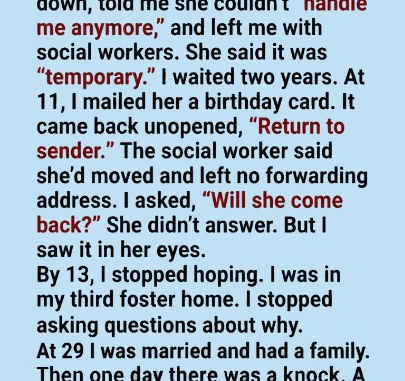
For two years I held on to that word. When I turned eleven, I mailed my mom a birthday card. Two weeks later it came back in the mail stamped Return to Sender.
“She moved away, didn’t she?” I asked.
Mrs. Patterson hugged me tightly, but the look in her eyes gave me the answer.
By the time I was thirteen and living in my third foster home, I stopped asking about her. Hoping only led to disappointment. I learned how to stay quiet, behave well, and take up as little space as possible.
Years passed.
When I was twenty-seven, my daughter Emma was born. The moment I held her, I promised myself she would never grow up feeling unwanted.
Two years later, life felt stable and happy. My husband Jake and I had built a loving home. Family photos covered the walls, and Emma’s toys were scattered across the living room floor.
I worked at a marketing company, we went on small vacations, and we had pizza nights and movie marathons together. For the first time in my life, I felt like I had the family I always dreamed about.
One evening after putting Emma to bed, I heard a knock at the door.
When I opened it, a thin woman with gray hair stood on the porch holding a grocery bag filled with cookies. Her eyes stopped me in my tracks.
They were my eyes.
“Hi,” she said quietly. “I need your help. I don’t have anywhere to live. You’re my only child.”
She didn’t ask about my life, my husband, or the granddaughter she’d never met. She stood there as if I owed her something.
I should have closed the door.
Instead, I invited her in.
At first she slept on the couch, then moved into the guest room. She acted grateful for a while—but eventually the comments started.
“Maybe things would have been different if you hadn’t been so difficult back then.”
“I was nine,” I reminded her.
“You cried all the time,” she replied. “You always needed attention.”
The final straw came when I overheard her talking to Emma one afternoon.
“Your mom was a hard child,” she whispered. “Sometimes you have to step away from people who hurt you—even family.”
Emma looked confused and uneasy.
That night I packed my mother’s belongings into a garbage bag—the same way she had packed mine years ago.
“You need to leave,” I told her.
“You can’t throw me out,” she snapped. “I’m your mother!”
“No,” I said calmly. “You’re someone who abandoned her child and came back looking for a place to stay—not forgiveness.”
I gave her the address of a nearby shelter.
As she walked out, she turned and said, “You’ll regret this. Family is everything.”
I shook my head.
“No. Love is everything. And you gave mine up a long time ago.”
A few weeks later, I mailed her a birthday card. Inside was only one sentence:
Sometimes you have to step away from people who hurt you.
I don’t spend time wondering about her anymore. What I’ve learned is something she never understood—being a parent isn’t about what you receive from your child, but about what you give.
And I will give my daughter everything. Including protection from anyone who might hurt her—even if they share her blood.
If you could offer one piece of advice to someone in this story, what would it be?
Let’s talk about it in the Facebook comments.
Leave a Reply