I’ve seen many forms of grief, but I never imagined it would unravel inside my own home. What my grandson created to heal almost ended up breaking him all over again.
My name is Ruth, and I’ve learned that when someone dies, their absence doesn’t leave—it lingers, quietly settling into the corners of a home.
My nine-year-old grandson, Liam, lives with me and his father. Two years ago, we lost his mother, Emily, to cancer. She was the kind of person who brought warmth wherever she went, and when she passed, something inside Liam dimmed.
It wasn’t sudden or obvious to most people—but I noticed.
He stopped laughing the same way, stopped rushing to the door, stopped asking for things like children usually do. He didn’t fall apart—he simply adapted.
The one thing he held onto was his mother’s sweaters. Emily had knitted them herself, and they still carried the faint scent of her lavender detergent. Liam kept them neatly folded in a box in his room. Sometimes he’d sit with them—not playing, not crying—just sitting.
About a year later, my son Daniel remarried a woman named Claire. I tried to accept her, but from the start, she made it clear she didn’t want those sweaters in what she called “her” house. Daniel brushed it off, saying she needed time, so I stayed quiet—for Liam’s sake.
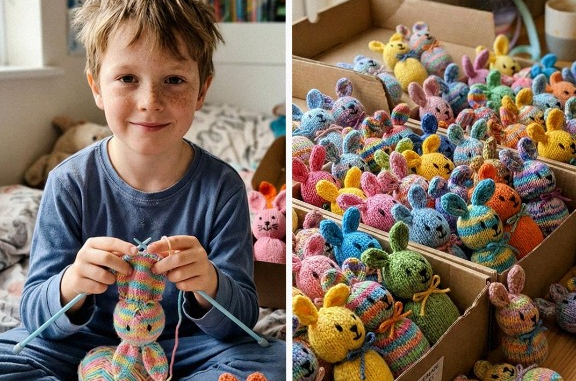
Then, a few weeks before Easter, Liam came into the kitchen holding a small, uneven bunny he had knitted.
“I made this for kids in the hospital,” he said. “So they won’t feel alone.”
My heart tightened. When I asked why a bunny, he gave a faint smile and said, “Mom used to call me her bunny.”
That was all the encouragement he needed.
From that day on, he worked constantly—after school, before dinner, even before bed. He carefully unraveled his mother’s sweaters into yarn and began knitting again, just like they used to do together. The bunnies weren’t perfect—crooked ears, uneven stitches—but each one carried meaning.
Soon, one became five, then twenty, then boxes full. Each bunny had a tag: “You are not alone,” “You are brave,” “Keep fighting.”
When I asked how many he planned to make, he simply said, “One hundred.” And somehow, he did.
For the first time in two years, I saw a spark return to him—not the same as before, but something filled with purpose and pride.
Then everything fell apart.
The day before we planned to deliver the bunnies to a children’s cancer ward, Liam and I were packing them when Claire walked in. She looked at the boxes and, without warmth or curiosity, asked what they were.
When I explained, she picked one up, glanced at it, and coldly said, “This is trash.”
Before I could stop her, she carried the boxes outside and dumped them into the dumpster—one after another.
Liam stood frozen, trembling. Then he quietly broke down, his silent tears somehow more painful than any outburst. I held him, not knowing what else to do.
That’s when Daniel came home.
Liam ran to him, crying, trying to explain. Daniel listened silently, holding him. Then, instead of reacting right away, he went inside and returned with a small wooden box.
When Claire saw it, her composure shattered.
Inside were old letters and photos—memories of someone she had loved deeply before. Daniel made it clear: just as she valued those memories, Liam valued his.
He told her to retrieve every bunny from the dumpster, clean them, and fix anything that was damaged.
This time, she didn’t argue.
She climbed into the dumpster and gathered every single one. Back inside, she carefully washed, dried, and reshaped them, working for hours without a word.
Later that night, Daniel returned her box and told her he wouldn’t throw it away—but he wouldn’t stay silent anymore either. He made it clear she couldn’t erase Emily or hurt Liam again if she wanted to be part of the family.
The next day was quiet. The bunnies lay drying across the table. Claire kept her distance, but I could see her watching them, as if finally understanding.
That evening, she called us together and apologized—first to Liam, then to all of us. She admitted she had tried to push him to let go of his mother, thinking it would make room for her. She said she hadn’t understood what those sweaters—and those bunnies—meant.
Then she did something unexpected.
She brought back the empty wooden box, handed it to Liam, and asked, “Can we start over?”
After a long pause, he accepted it—and hugged her.
Weeks later, the bunnies were ready. Cleaned, repaired, and filled with meaning. Liam asked Claire to come with him to deliver them, and she agreed, staying quietly by his side the whole time.
He later told me the children held onto those bunnies like they truly mattered—because they did.
On the way home, he rested his head against the window and said softly, “Mom would’ve liked that.”
Claire didn’t say anything—she just nodded.
And for the first time since she entered our lives, I believed she was finally beginning to understand what it means to truly belong.
Leave a Reply